
The Men's Fragrance Brief as a Decision Framework, Not a Wish List
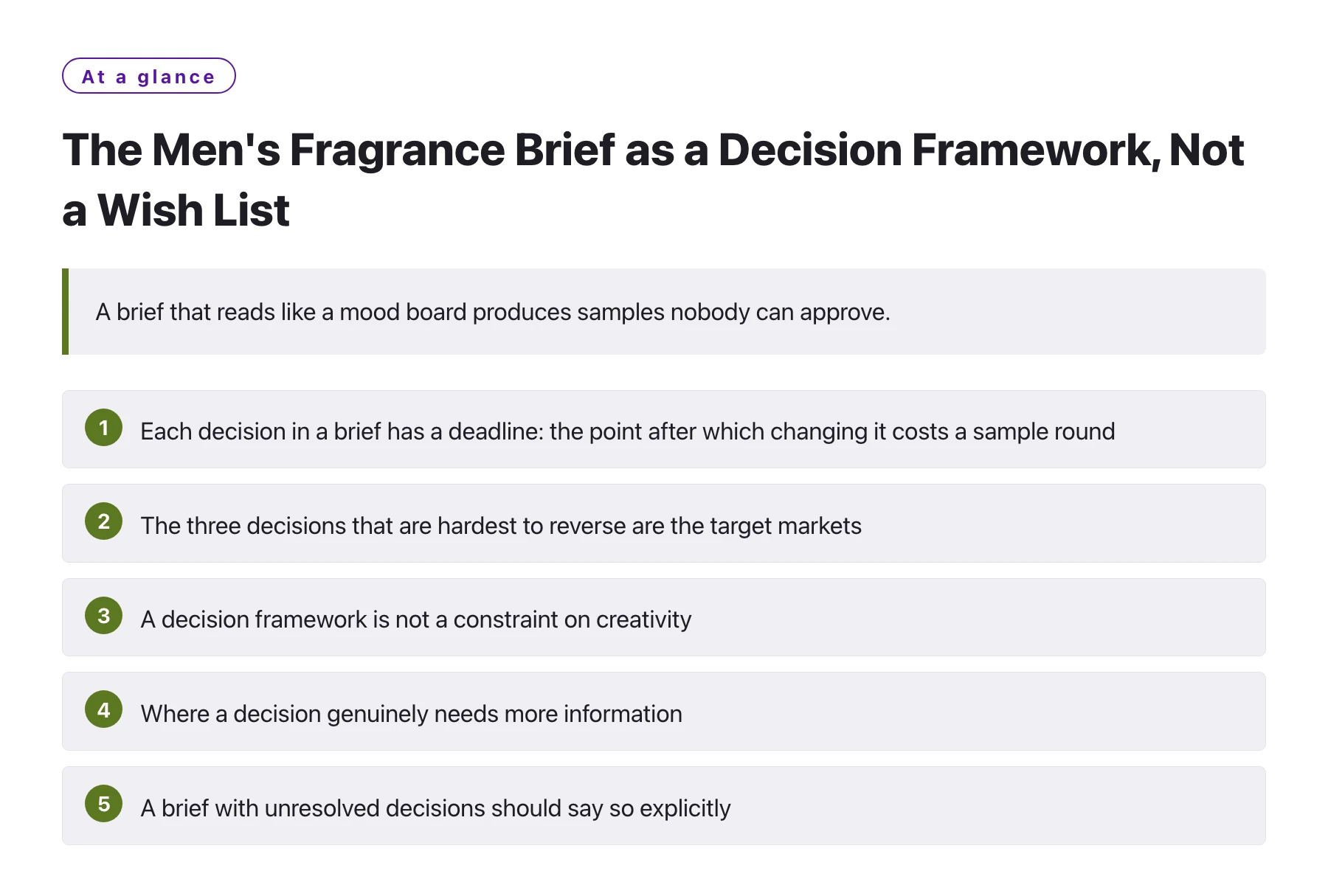
A brief that reads like a mood board produces samples nobody can approve. A brief that reads like a decision framework produces a project that can be scheduled. The difference is that every line in the second version closes off an option — concentration, market, format, price ceiling, compliance route — and names the latest moment at which that decision can still be changed cheaply. That is what turns a creative document into a working one.
Key takeaways
- Each decision in a brief has a deadline: the point after which changing it costs a sample round, a test or a print run.
- The three decisions that are hardest to reverse are the target markets, the packaging format and the price ceiling, so they belong in the first draft.
- A decision framework is not a constraint on creativity; it is what allows a perfumer to explore freely inside a defined space.
- Where a decision genuinely needs more information, write down what would settle it and who is going to find out.
- A brief with unresolved decisions should say so explicitly, rather than leaving them to be discovered during production.
Wish lists and briefs look similar on paper: both describe what the brand would like. The difference is that a brief assigns consequences. If the format is a 50 ml spray, the pump, the glass and the fill weight follow. If the market is the European Union, the labelling and documentation follow. If the price ceiling is fixed, the perfumer knows how much room the formula has.
Buyers resist writing decisions down early because decisions feel premature. The practical answer is a decide-by date rather than an immediate choice: the brief can record that a decision is still open, provided it also records when the decision must be made and what it will cost to change afterwards.
Seen this way, a brief becomes a schedule of commitments, and the project acquires a shape that can be walked backwards from a launch date.
Decisions, deadlines and what each one locks
| Decision | Decide it by | What it locks |
|---|---|---|
| Target market list | First brief draft | Labelling, notification, allergen declaration thresholds and the tests that must travel with the goods |
| Price ceiling at retail and at cost | Before sampling | The material palette, the concentration range and the packaging options the perfumer can consider |
| Format and concentration | Before the first mod is built | Pump and valve specification, fill weight, headspace and how the scent reads on skin |
| Scent territory and references | Before sampling | The direction the perfumer explores and the benchmark the panel will judge against |
| Packaging route: stock or bespoke | With the brief | Tooling cost, minimum order quantity and the packaging lead time on the critical path |
| Approval authority | Before the first sample ships | How quickly feedback consolidates, and whether rounds converge or repeat |
| Compliance route and document owner | Before artwork is finalised | Who prepares each document, and which responsibilities stay with the brand rather than the factory |
Read down the second column: it is a schedule, not a preference list. Most projects that run late have one decision in this table that was never given a deadline and therefore drifted into the middle of production.
Why the market decision comes first
Of all the entries above, the market list has the widest reach, because it determines which regulatory and labelling obligations apply to the finished product. Those obligations then constrain the formula and the artwork, and both are expensive to change.
This is a reason to be conservative about adding markets mid-project. Each addition may require a fresh formula review, an updated allergen declaration and, in some markets, a notification step that has its own timeline.
Safety review follows the formula, not the story
Scientific advice on fragrance materials and allergens is issued and revised over time, and the conclusions feed into how a finished product is assessed [1]. A formula that was reviewed last year may need a second look if the review basis changes, particularly where a material carries a low permitted level. Writing the market list into the brief makes that check routine rather than reactive.
Different markets, different paperwork
Selling the same bottle under two jurisdictions means meeting two sets of cosmetic requirements. Health Canada publishes its own guidance on cosmetic safety and labelling for products sold in Canada, which differs in detail from the European approach [2]. For a men's line, the practical effect is that the compliance route belongs in the brief alongside the scent direction, because it changes what the factory has to supply and what the brand has to hold.
Turning the framework into a working brief
- List the decisions before writing the descriptionStart with the table above and mark each row as decided, open or deferred. A brief that names its own gaps is far more useful than one that reads smoothly and hides them.
- Attach a date and an owner to every open itemAn open decision with a deadline is manageable. An open decision without one becomes a surprise during production, usually at the least convenient moment.
- Translate each decision into a consequenceWrite one line under each decision explaining what it rules out. This is what allows the perfumer and the packaging team to work without repeatedly asking for confirmation.
- Name a single approval authorityOne person or role decides, even if several people give input. Sampling rounds converge when feedback comes from one place and is written against a reference.
- State how a decision can be reopenedSome changes will be necessary. Say what triggers a review, what it costs and who approves it, so that reopening a decision is a process rather than a negotiation.
- Review the framework at each stage gateRe-read the table before each approved milestone. Decisions that were deferred often reach their deadline earlier than expected, and catching that at a gate is cheap.
The most useful single line in a brief may be the one that says which decisions are still open. It signals that the document is honest, and it gives the manufacturer something concrete to help resolve — often faster than the brand could alone. Buyers who want to see how a development team responds to that kind of brief can read a manufacturer's own description of how it structures the work, starting from Xuelei's website, and compare it against the table above. The same test applies to the parties involved: a a manufacturer that builds custom scents will recognise a decision framework immediately and start closing the open items, while a supplier that quotes from a catalogue may not need one at all. Understanding the company behind the factory — how long it has been developing fragrances and for whom — is a reasonable way to judge which of those two conversations you are about to have.
Sources
- EU Scientific Committee on Consumer Safety (SCCS) —— The EU scientific committee that issues opinions on the safety of cosmetic ingredients, including fragrance allergens and their labelling thresholds.
- Health Canada: Cosmetic Safety —— Health Canada's cosmetics pages, covering cosmetic notification, the ingredient hotlist and safety requirements for cosmetics sold in Canada.
Frequently asked questions
Is a decision framework too rigid for a creative fragrance project?
It is the opposite. Fixing the market, price ceiling and format gives the perfumer a defined space to explore, which is more productive than an open field. Creativity suffers most when constraints arrive late and invalidate work that was already done.
Which decision should be made first?
The target market list, because it determines labelling, documentation and testing obligations that constrain the formula and the artwork. Price ceiling and format come next, and the scent direction follows from those three.
What if we genuinely do not know which markets we will sell in?
Start with the primary market and treat additional markets as a documented change with a cost. It is also reasonable to develop for the strictest likely market first, provided the brief states the assumption and its implications for cost and materials.
How many decisions can still be open when sampling starts?
Format and market should be settled, because they shape the formula and the tests. Packaging decoration, label wording and secondary formats can remain open a little longer, provided each has a deadline and a stated cost to change.
Who should own the decision framework?
The brand owns it, because the decisions are commercial. The manufacturer's value is in flagging which decisions have reached their deadline and what a late change will cost, which is why the framework should be shared rather than kept internal.