
A Multi-Coin Pool Explained Through One Day of Output
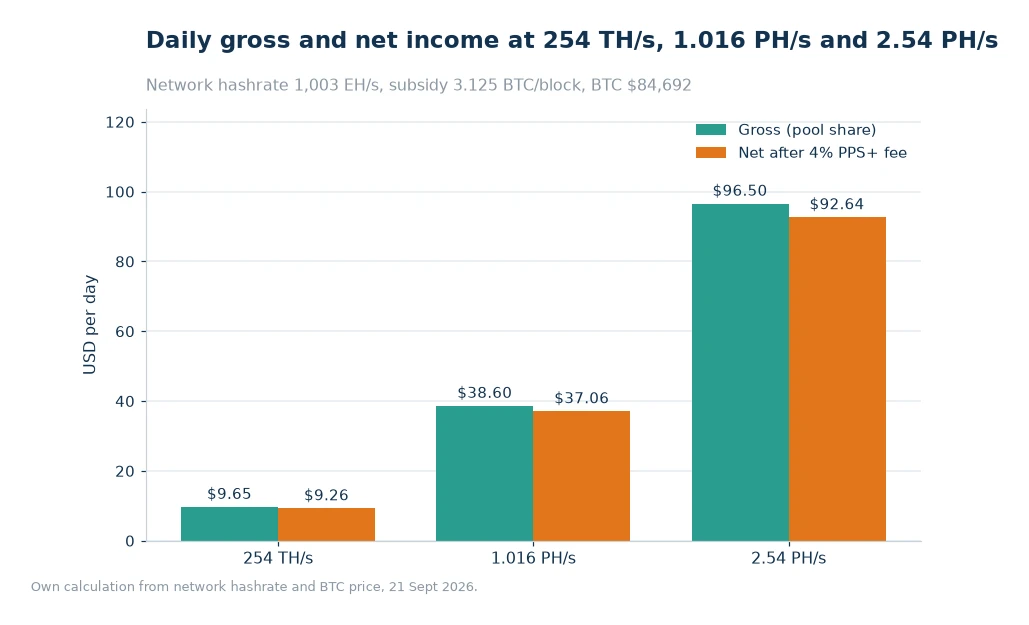
A mining pool is a clearing house: it pools hashrate, finds blocks, and divides the proceeds by a published rule. At 254 TH/s the rule pays 0.00011395 BTC a day, worth $9.65 at $84,692 per BTC and $9.26 once the listed 4% on the block-reward component is taken. The interesting questions are what happens between finding a block and that number appearing, and what the account does with the coins afterwards.

Key takeaways
- 254 TH/s is 0.0000253% of a 1,003 EH/s network and produces 0.00011395 BTC a day, or $9.65 gross.
- Four times that hashrate, 1.016 PH/s, produces 0.00045583 BTC and $38.60 gross; ten times, 2.54 PH/s, produces $96.50.
- PPS+ pays hourly against current difficulty, so the daily figure arrives in 24 instalments rather than one.
- The same account holds 20+ coins, a multi-currency wallet and Auto Conversion, which keeps payouts and conversions on one statement.
What the pool is actually doing
Every miner in a pool submits shares, which are proofs of work that fall short of a block but are rare enough to measure contribution. The pool tallies those shares, and when one participant finds a block the reward is split according to the payment method in force. Bitcoin issues 3.125 BTC per block and produces 144 blocks a day, so the pool and every other pool are dividing 450 BTC daily. Nothing in that description requires trust; it requires a published rule and a visible share count.
That is why the payout method deserves more attention than the marketing around it. A method sets both the percentage deducted and the moment income becomes final, and the second half of that sentence is the part most comparisons leave out. Two pools quoting the same headline rate can produce different balances on the same day if one settles hourly and the other waits for confirmations. Read the rule first, then the rate, then the dashboard.
Multi-coin coverage in practice
ViaBTC Mining Pool runs as an all-in-one multi-coin pool with 20+ coins, including BTC, BCH, LTC and DOGE in merged mining, plus KAS, ZEC, HNS, CKB and ETC. For an operator with mixed hardware that matters: a Scrypt rig and a SHA-256 rig can report to the same account, and the payout history reads as one ledger instead of two portals with different login rules.
Coverage also decides what happens when a coin's economics turn. Moving hardware between algorithms is a physical job, but moving a payout balance between coins is not, and a pool that lists both the coin you mine and the coin you want reduces the number of transfers in between. The service footprint is quoted at 150+ countries and 1M+ users, which in practice means regional endpoints and a support queue that is awake when you are.
Two settlement rules, one balance
PPS+ is the default. The block-reward component is settled on a PPS basis at a listed 4% and the transaction-fee component at a listed 2%, with payment every hour against current difficulty. Splitting the rates this way is deliberate: the subsidy side is the predictable part of income, and PPS+ removes pool luck and orphan-block risk from it, which is what the higher listed rate on that component pays for.
PPLNS applies a listed 2% to the block reward and fees together, then pays after 6 confirmations, allocating each miner a share based on their slice of pool hashrate across the last 5 difficulty rounds. Round-to-round variance lands on the miner, and the lower listed rate is the compensation. Neither rule is a discount or a penalty. They are two ways of pricing the same uncertainty, and the right one depends on whether you need a steady daily number or can absorb a quiet week.
The daily arithmetic at three sizes
Output scales with hashrate and nothing else. Price and difficulty decide the dollars, hashrate decides the share, and the listed rate takes its cut of the block-reward side. Put the three together and the whole income statement fits in four columns.
| Hashrate | Share of network | BTC per day | Net USD per day |
|---|---|---|---|
| 254 TH/s | 0.0000253% | 0.00011395 | $9.26 |
| 1.016 PH/s | 0.0001013% | 0.00045583 | $37.06 |
| 2.54 PH/s | 0.0002532% | 0.00113946 | $92.64 |
The net column is the one to compare against a power bill, because it is what the pool actually credits. Gross income at 2.54 PH/s is $96.50 a day, and the difference of $3.86 is the listed 4% on the block-reward side. That $3.86 buys hourly certainty on the subsidy component, and on a machine drawing several kilowatts it is a small line next to electricity.
Worked example
Use 254 TH/s, the smallest band in the chart, and follow the pool formula one multiplication at a time.
- Daily output per terahash is 450 BTC divided by 1,003,000,000 TH/s, giving 0.00000044865 BTC.
- Multiply by 254 TH/s: 254 × 0.00000044865 = 0.00011395 BTC per day.
- Multiply by $84,692 per BTC: 0.00011395 × 84,692 = $9.65 gross.
- Take the listed 4% on the block-reward component: 4% of $9.65 is $0.39, so net is $9.26.
- Scale to 1.016 PH/s, exactly four times the hashrate: 4 × 0.00011395 = 0.00045583 BTC, or $38.60 gross and $37.06 net.
- Scale to 2.54 PH/s, ten times: 0.00113946 BTC, $96.50 gross, $92.64 net.
- Thirty days at 254 TH/s: 0.0034185 BTC gross, $289.50, less $11.58 in listed fees, leaving $277.92.
After the payout arrives
Coins credited are not coins banked. A multi-currency wallet inside the same account holds the balance, and Auto Conversion moves value between listed coins at the moment you choose rather than on a fixed schedule. For a miner who pays costs in one currency and accumulates in another, that is the difference between a payout and a usable treasury. Withdrawals of mining income carry no fee, so the only cost that touches the balance is the listed rate already applied.
Hardware questions sit one level down. The Miner Profitability Ranking compares ASIC models against current coin prices and difficulty, and Mining Farms lists hosting options for operators who would rather rent a slot than build a room. Neither tool predicts anything; both compress a spreadsheet into a page. Used together with the ViaBTC Profit Calculator, they answer the only question that matters before a purchase: at today's numbers, does this machine cover its own power?
Frequently asked questions
How quickly does a payout become available to withdraw?
Under PPS+ the credit lands every hour against current difficulty, and mining withdrawals carry no fee; under PPLNS the balance moves once a block has 6 confirmations, which adds time but not a charge.
Can one account mine Bitcoin and another coin at the same time?
Yes. The pool lists 20+ coins, so separate rigs can point at different algorithms while reporting into one account, and merged mining adds LTC and DOGE output for Scrypt hardware.
Is the listed 4% charged on everything I earn?
No. It applies to the block-reward component only; the transaction-fee component carries a listed 2% under PPS+, and under PPLNS a single listed 2% covers both components together.
Check the rule before the rate
Three sentences settle whether a pool suits your operation: how it splits the block reward from transaction fees, when it settles, and what it charges on each part. The dollar amounts follow from your own hashrate, and the arithmetic in this article takes about a minute with a calculator. Repeat it when difficulty moves, as it was estimated to by −2.12% at the next adjustment, and the decision stays current instead of aging into a guess.
Sources: the ViaBTC pool and fee pages for payment methods, product names and listed rates[1], plus chain data read 21 Sept 2026 — network hashrate 1,003 EH/s, difficulty 132.76 T, 3.125 BTC per block, 144 blocks a day, BTC $84,692 — published 22 Oct 2026. Dollar figures are arithmetic on those inputs, not forecasts.